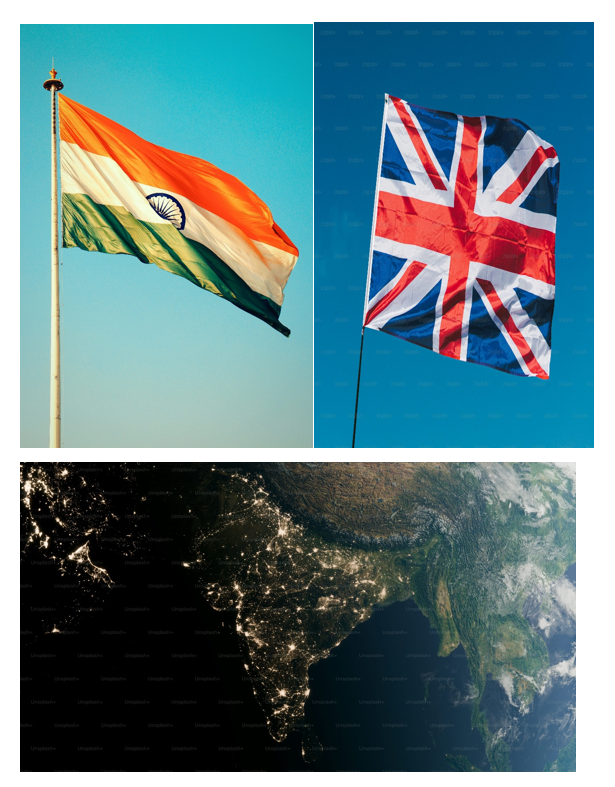
Let us not delve into the WHYs and WHEREOFs of “how we came to be;” as nevertheless, we do share a collective history. This history reflects a cognitive progression of identity and development, encompassing self-discovery, familial relationships – the famous and infamous, and possible kinships and friendships. And now, due to advances in DNA technology we are able to accurately identify the geographical origins of our ancestors.
Let us take Genealogy:
It is the study of individuals, families, family history, or pedigrees. This involves a lengthy process whereby we research historical records through resources available on the internet, local libraries, and genealogical sites to establish kinship and formulate pedigree charts that show “who is who” in a family, how the kinship evolves into descendants or ancestors in each individual family.
However, the information and research cannot be completed orally alone. And, not all countries have equivalent professional organizations to enhance your research, in which case you can search the Internet Highway for a plethora of websites to further your research. For example, some free websites like: Familysearch.org (merged with Findmypast, a subscription-based website), Cyndy’s List at www.cyndislist.com and others listed in the “Suggested Resources” Blog. Link:
If your heritage traces back to India—whether your ancestors arrived with the British Military in the 1600s or they are descendants of later generations of Indian and British origin—They are part of a notable legacy in Colonial India. A web of individuals that include those born in India, individuals who migrated IN to India and lived there, had liaisons or intermarried for decades, whose families remained in India and those who passed away in India, or those who eventually emigrated to OR took a route OUT-OF-INDIA to all corners of the globe.
Thus, without delving into our origins, we naturally assume ourselves to be individuals connected through parents, grandparents, children, and generations who came both before and after us.
To learn who came to India, you must search multiple levels to find out who they were, their reasons for leaving their homes, how they arrived, and from where:
First: What do you already know:
- Your Name
- Your nickname
- Your Birth Date
- Your Baptism Date
- Your Place of Birth
Second: What do you already know about your parents:
- Their names
- Their Birth Dates
- Their Baptism Dates
- Their Places of Birth
- Their Occupations
- Their Marriage Dates
- Their Places of Marriage
- Their Dates of Death
- Their Places of Death/Burials
- Their residences at each event
Obviously, there is going to be gaps in your research, and not all the information is available. So, ask your nearest and dearest to recollect all they can about the family and keep meticulous notes about them, that is: the cousins, the aunts and uncles, grandparents, godparents or sponsors, family friends, and even parish priests.
Third: What do you already know about your grandparents?
- Their names
- Their Birth Dates
- Their Baptism Dates
- Their Places of Birth
- Their Occupations
- Their Marriage Dates
- Their Places of Marriage
- Their Dates of Death
- Their Places of Death/Burials
- Their residences at each event
Fourth: All these questions will probably generate more detail-oriented responses that would further expand your initial research, and those records may be deemed of permanent value for historical family purposes.
How to start researching your family:
It does not matter where your ancestors were born, lived, married, or died. Every culture has kept some form of record. For example:
China keeps detailed records of family going back thousands of years. The only source that I know of that has families recorded that goes back generations. These records document patrilineal lineages, often tracing descent from a common ancestor across hundreds of generations. They include detailed information such as male ancestors’ names, birth and death dates, marriage details, official appointments, clan rules, migration histories, and generation poems used to guide naming conventions.
The United Kingdom has a centralized record system housed at the British Library, for one, for births, marriages, deaths, probate records, property records, and much more. It is one of the largest libraries in the world that can be researched online or at their main offices. It also houses other countries’ records where colonization took precedence.
Another source is familysearch.org, which is the largest genealogy organization in the world. It is a nonprofit organization and offers genealogical records, education, and software. It is operated by the Church of Jesus Christ of Latter-day Saints and is part of the Church’s Family, based in Utah, USA, and various outside sources have access to these records to help further your research.
Even colonization preserved various records, including commerce, property, personal data, and vital statistics. These country-specific records remain accessible online or through onsite research in their original locations or offsite at Colonial offices of record. See “Suggested Resources.”
Further, most websites that cater to genealogy are subscription based and expensive. Many records including births, marriages and deaths as well as census records from 1841 to 1921 (or country specific) are now available online. But you must be aware that most records that are available may not be exactly precise. That is, it may be incorrect because there may be transcription errors, information supplied may be wrong and enumerators may have made mistakes when completing the forms. Also, some subscription web sites host public family trees which often contain member specific errors or transcription errors.
However, there is a wealth of information available that is not online and the benefit of using a professional service , which is expensive, to say the least, but they have knowledgeable “know-how” as to what kind of records can assist in finding information and where to look for those records.
On some websites, duplication may arise with many family trees “barking up the wrong family tree,” and may be hard to correct. So, keeping an accurate tree must be meticulously researched and compared to. Strict rules for recording are, therefore, a must.
Keeping simple charts, or pedigree charts is the norm, and many sites cater to printed forms that are quite handy and help keep your family tree in focus.
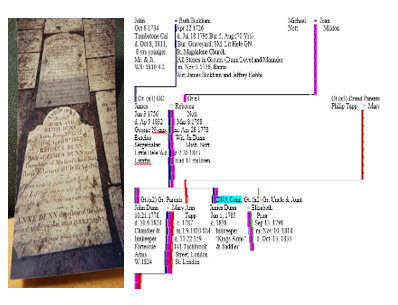
One example shown below is of using a tombstone’s information to expand your research and keep your chart accurate:
- all notifications, notes, medals, etc.
- Relatives may have information to add to your lists.
- Ask relatives and/or visit them, especially older ones
- Write, phone, or email them if no one is nearby.
- Check to see if others may have more details and are willing to share. Not all are forthcoming for crazy reasons, but worth considering.
- In addition to possessing vital information, family members may also know family stories that can be collected and preserved for future generations and may assist in your continuing research.
Note: Data entry for each piece of information obtained is crucial. You can always look back on your notes and strengthen your narrative on the focused individual(s).
Once you have the basic data, work backward chronologically from known individuals. Along the way you will pick other sources and resources, especially when you can troll the internet from your armchair. Keep a tab on the resources so that you can always go back to it to do more research, confirm, or verify the information.
- Use birth records or death recordsto find parents’ names, then search online, census records, to obtain more information as to estimated birth dates and places of birth, occupation, and/or other family members who may have graced that census record.
- Use marriage recordsto verify and expand your tree.
- Explore local archives, historical newspapers, church records, and military or immigration recordsfor deeper clues.
The next step is knowing and familiarizing yourself with certain phrases to help you keep track of kinship and/or implied kinship:
Generation:
A generation refers to all of the people born and living at about the same time and regarded collectively. It can also be described as, “the average period, generally considered to be about 20–30 years, during which children are born and grow up, become adults, and begin to have children.
Thus, our parents come from an earlier generation, e.g. 1900s, and our grandparents before them, 20+ years earlier, e.g. the 1880s. Your siblings, cousins, and yourself were probably born in the mid-1900s, while your children were born a generation later. A family tree illustrates these connections between you and your ancestors.
Similar to traditional family trees, this method includes siblings, aunts, uncles, and cousins for thorough results. It also helps identify and determine the number of “cousins” in any generation since the 1600s or earlier based on available written records.
Generation Length:
The generation length is the age of parenthood of a number of children, either in one generation or across several generations
Average Generational Length:
The average generation length is found generally at the birth of the middle child.
Interval or Range between Generations:
The Range consistently narrows generations or reaches unusually longer spans in certain families. Various formulae can be used in the above context.
For example:
First Cousins have a common ancestor – Grandparents
Second Cousins have a common ancestor – Great grandparents
Third Cousins have a common ancestor – Great-Great-Grandparents And so on.
Below is a table that would give you a fair assumption of who makes up a generation:
| GENERATION | RELATIONSHIPS | SETS OF GRANDPARENTS | |
| “ZERO” | YOU | YOU | |
| 1 | Parents | 2 Parents | |
| 2 | Grandparents | 4 sets of Grandparents | |
| 3 | Great Grandparents | 8 sets of Great-Grandparents | |
| 4 | 2nd Great Grandparents | 16 sets of 2nd Great-Grandparents | |
| 5 | 3rd Great Grandparents | 32 sets of 3rd Great-Grandparents | |
| 6 | 4th Great Grandparents | 64 sets of 4th Great-Grandparents | |
| 7 | 5th Great Grandparents | 128 sets of 5th Great Grandparents | |
| 8 | 6th Great Grandparents | 256 sets of 6th Great Grandparents | |
| 9 | 7th Great Grandparents | 512 sets of 7th Great Grandparents |
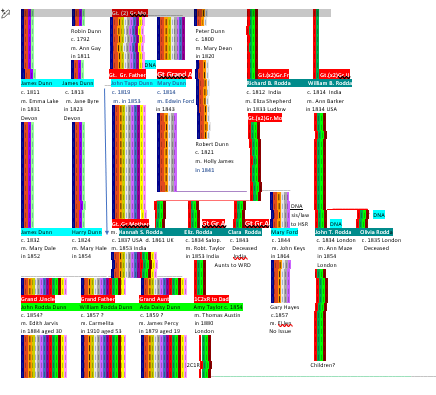
You will note that each generation doubles as you get further back. So, to form a more precise chart you need to start with you. It is necessary to note that individual, family, or pedigree charts may be drawn in several ways to portray your ancestry. There are no rules to follow, but your own. Keep it consistent.
One example:
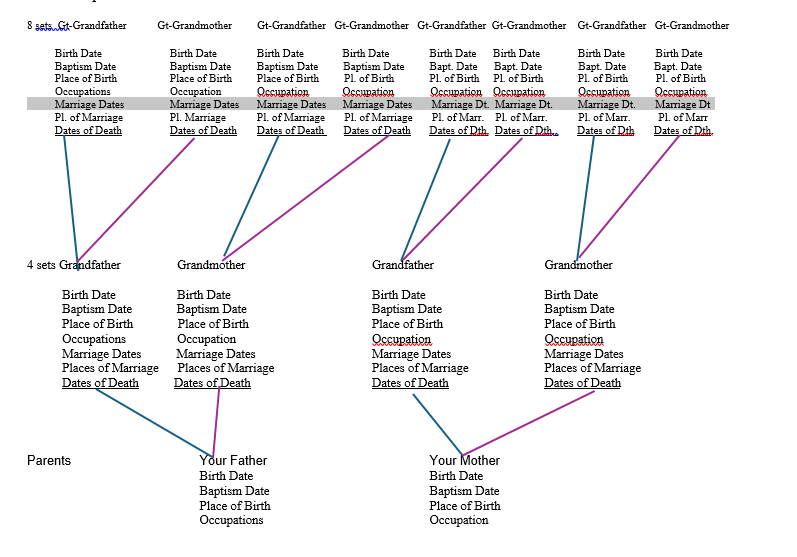

The above converts to:
Disparate Ages:
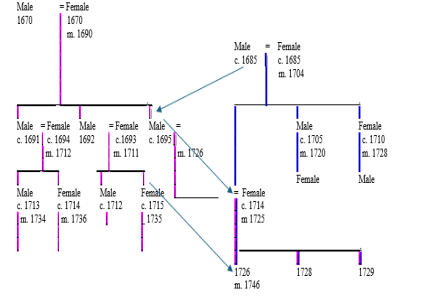
Or
Pedigree Chart
TO BE CONTINUED