My name is Moira Marjorie Dunn. I began this work for a simple reason: I wanted to write myself into the genealogy history books before anyone else erased or rewrote me.
It is a narrative that intensifies my findings on the four continents of Europe, the UK, India, and the USA. A journey IN and OUT-OF-INDIA which was an adventure in itself, which set me off on a wild goose chase across continents, by land, sea, and air. This ultimately led me to believe that my ancestors’ arrival in India contributed to my family’s eventual exodus OUT-OF-INDIA.
My family’s story also crosses the subcontinent of India and the presidencies of Bombay, Calcutta, and Madras (historical names will be used throughout), the global network of the United Kingdom, Europe, Asia, Australia, and the United States of America. Not to forget the intra-mingling of various families’ traumas and dramas as subsequent progressions were made.
It unravels the family Patriarch’s biological family based on a simple baptism certificate 10 years after his birth in Calcutta, Bengal – A baptism into the Catholic religion, when intensive research shows an Anglican background.
It also includes lost papers and name variants that conceal more than they reveal. What follows is my own account—told in the first person—of why I started, how I worked, and what I found.
Why I started
I grew up amid scraps of information and a lot of silence. On my mother’s side, the facts were stark: her parents—Stanislaus Saunders and Paulina da Fonseca—died a week apart during a pneumonia epidemic in 1925 and were then taken in by their paternal grandmother, Lillian Saunders. A custody suit in the High Court of Bombay placed my mother and her brother with their maternal aunt, Carmelita, and her husband, William Rodda Dunn, in Belgaum. Contact with their paternal grandmother, Lillian Saunders, ceased after the judgment. Years later, I learned Lillian died in 1935.
On my father’s side, I was told my grandfather was “born abroad,” in Ireland to be precise, and arrived in India as a child. He and spent a career in the Public Works Department (PWD) right up to his death in 1928. His employment spanned the presidencies of Bengal, Calcutta, Bombay, Poona, Bangalore, and Madras. There was also a large family house in Belgaum and a family tendency not to talk about any of it. I resolved to replace myth with evidence, document by document.
These patterns—big events, thin paperwork—became the signature challenge I set out to solve
How I worked
I taught myself the old-school way: request indexes, pull volumes, check every spelling, and compile lists, file folders, and individual cards, for every Dunn, Rodda, and Tapp families across the three Presidencies.
The initial forays were made in the 1970s at St. Catherine’s House (Public Records in the UK) and the India Record Office (Orbit House, Blackfriars), Guildhall, and Bishops Transcripts in South Molton, Devon. Research into births, marriages, and death records at the Devon Records Office in Exeter, Devon; other libraries in various UK counties and global countries; and the most valuable of all sites, the Church of the Latter-Day Saints records held by the Society of Genealogists at Harrington Gardens, in London. I chained together birth, marriage, and death registers; census records for the whole of England and the USA; orphanage entries; staff lists; and directory snippets.
This also meant hefting books twice my weight, long waiting periods, and frowning clerks who no doubt could not wait to get me out of their search rooms by slow walking requested books, materials and other records, or irksome things of such nature.
When the paper chase ran thin, DNA or “jus sanguinis” (right of blood) was pursued —triangulating 1st–10th cousin matches and global regional signals—to help confirm or nudge the paper trail.
Whenever a name wobbled, I leaned on signatures, occupations, and co-occurring names to prove identity. Where a date didn’t exist, I used bounded estimates—anchored to a dated life event I could prove—to avoid wishful thinking.
THE MATERNAL LINE: NORTHERN & SOUTHERN INDIA, GOA, PERSIA, ANATOLIA, BOMBAY, BELGAUM, AND A COURT CASE
My mother was born in Bhusaval. Her father, Stanislaus Saunders, worked as a Guard on the Great Indian Peninsular Railway (Sholapur). Family memory also remembered him as a Headmaster in Byculla around the 1920s. Both he and my maternal grandmother Paulina died in 1925, one week apart. My mother and her brother were then the subject of a custody battle in Bombay: the court awarded guardianship to my paternal grandfather William Rodda Dunn, after which the children were taken to Belgaum and raised by Carmelita (their maternal aunt, who is also my paternal grandmother). Decades later, I confirmed that Lillian Saunders (their paternal grandmother) died in 1935
My mother’s maternal grandparents—Antonio Francisco da Fonseca and Maria Joaquina de Oliveira—were Luso-Indian from Tivi (Goa) who moved to Bombay. After Maria died, the children were placed at Bandra Convent; Her grandfather Antonio Francesco visited when she was about five, and Antonio worked in the flour mills. Her uncle, Antonio, visited once on his way to Africa, where he died of typhoid or yellow fever.
THE PATERNAL LINE: A DELAYED BAPTISM AND A VERY LONG CAREER
My paternal grandfather, William Rodda Dunn (Sr.), was baptized ten years after his birth at Moorghetha Orphanage, Calcutta, into the Catholic religion, in 1867. His baptismal names were recorded as William Stanislaus Dunn; the entry lists his parents as “John & Hanover” Dunn. The same day, an older brother, John Aloysious Dunn, was baptized with the same parents noted. That pairing of names, date, and place is how I tied the brothers together.
Initially no mention of a sister or any other sibling was made other than the two brothers. A sister, vaguely named Lucy, was mentioned and no trace of her was found until a marriage in 1879 of an Ada Daisy Dunn was uncovered, and whose father was named John Dunn, Cabinet Maker. The wedding was to James Percy, a Tea Plantation owner, of Dibrugarh, Assam,
From there, the paper trail grows: the brothers were recorded as priests for the Irish Christian Brothers in Calcutta, a Jesuit Order, for the next several years, and by 1883, the brothers appear as assistants at Eugene & Co. in Calcutta; in 1884, John Rodda Dunn marries Edith Agnes Jarvis and soon becomes a Railways Guard in Allahabad, and the names John Rodder Dunn and William Rodder Dunn were noted on the certificate.
By 1885, my grandfather enters the PWD (as an accountant) in Calcutta, later transferred across Bengal, Bombay, and Madras. PWD lists preserve his date of appointment and grades; they show continuous service through to 1928, and in quite a few instances he was recorded as being in India for 36 years and 5 months. Before retiring, he bought a house on 3 acres of land in Belgaum, had six children and died in 1928.
I had noted the 1853 Calcutta marriage entry for my great-grandparents—John Tapp Dunn and Hannah Sophia Rodda—on the same page as Elizabeth Inshaw Rodda and Robert Taylor; both brides names Richard Burrows Rodda as father, confirming the Rodda linkage I suspected from the brothers’ middle names. I had set the marriage aside as I was unsure of the connection, but it proved intriguing and over time proved invaluable.
MY FATHER’S THREAD
My father—William Rodda Dunn (Jr.)—was born in Bangalore while his father was posted there. He grew up in Belgaum, attended St. Paul’s High School (Jesuit order), and, after his father’s death in 1928, joined the Telegraph service in Fort, Bombay. Over the decades, unbeknown to him, he followed in his father’s footsteps and was transferred across the three presidencies and districts, eventually becoming Traffic Manager / Acting Director for all of India. He retired in 1967.
PLACE AND TEXTURE: BELGAUM AS ANCHOR
Belgaum was our fixed point, our family home. The house my grandfather purchased had about 14 rooms, a long driveway, a guest house, and servant quarters that over time progressed from basic necessities to a modernized facility, as families and fortunes shifted. It was a place we returned to for school holidays, relief from the relentless heat of summers, and family rites—an anchor after years of postings and transfers.
ME!, MYSELF!, AND I!
I WAS BORN AND RAISED IN INDIA, enjoying a privileged life with access to the best education and surrounded by servants at our beck and call until my marriage. The schools were run by Jesuit priests and nuns of the Carmelite order, with an English curriculum that ended with a matriculation qualification at the end of their school years. Thus, India was my oyster.
For myself, I knew no other life and unlike any Indian traditions which were so remote as to be unmemorable, and I did not spare a thought for my Anglo-Indian identity when abroad as I seemed to fit in. I was so sheltered that growing up, the outside world did not encroach until I married and left India. I never saw poverty, the malnourished or the slums, but I did not live wholly in a cocoon.
Living in a community that had the same values, the same structure and culture, politics happened in the background and discussed by elders and if it trickled downwards, were dismissed.
For me the social life was fun and characterized by lively social gatherings, where the community regularly came together to enjoy each other’s company, and which were known for being warm, fun-loving, joyful, and always ready with a joke and a smile. Music played a central role on these occasions, serving as a unifying force that brought people closer.
METHOD NOTES (WHAT ACTUALLY WORKED)
For me: a baptism 10 years after the event into the Catholic religion, with differing parents’ names, a PWD appointment with grades from 1st to 4th grade that showed his terms of office; marriage registers that again showed differing names and surnames. Each added uneasiness, frustration, contradictions, and finally confidence to the next search step.
The baptismal names of Aloysious and Stanislaus, the appearance of the mother’s names of Hannah/Hanna/Anna and even “Hanover” appear against the same woman; and the Rodda/Rodder last names, appear in signatures. I never treated a variant as a separate person unless the dates and context forced it.
The prominence of the “Rodda” middle names suggest it was of significant importance to them, possibly beyond the reach of their conscious memory. The baptismal middle names of “Aloysious and Stanislaus” were never used again in adulthood and subsequent documentation.
Family memory claimed Irish birthplaces; an affidavit from a school boarder remembered my grandfather saying Cork. I pursued it but accepted the negative findings when UK/Ireland repositories didn’t confirm it.
DNA as a guide, not a verdict for Maternal History. My matches and regional estimates (Northern India/Gujarat–Maharashtra, Persia/Anatolia, European components) supported what the documents were already pointing at on the maternal side—and highlighted where the paper record is still thin.
On the paternal side whilst researching, nothing pointed to a United Kingdon contingency, until intensive research unearthed myriads of information that spanned four continents: The UK, Europe, Asia, and the USA.
The Unidentified Foreign Object – my grandfather William Rodda Dunn, first appeared in the Devon Family Historical Society’s journal in Early 1980.
The book entitled “I AM MY OWN ANCESTOR. THE BLACK SHEEP OF THE FAMILY highlights the sequel to the UNIDENTIFIED FOREIGN OBJECT and the eventual truth, that verified him as the IDENTIFIED FOREIGN OBJECT.
DNA EVIDENCE
DNA evidence proved “jus sanguinis” (right of Blood) and the family pedigree or heritage in South Molton, Devonshire, Sancreed, Cornwall, Brooklyn, Kings County, USA., and all the counties in-between, personifies my grandfather, now the IDENTIFIED FOREIGN OBJECT. A painstaking process to prove “jus sanguinis” the right of blood, which is now moot as the whole family is now resident in the UNITED STATES OF AMERICA, and where eventually I will reach the pinnacle of ascent as the matriarch, looking down on the success of the long road to achieving ANCESTORSHIP.
DEVON/CORNWALL ROOTS
The baptismal record that opened the proverbial pandora’s box spreading a tangible global route to my paternal ancestors in South Molton, Devonshire, and the paternal/maternal route to Sancreed, Cornwall.
SELECTED MICRO-TIMELINE (EVIDENCE POINTS)
- 1847/48 John Tapp Dunn’s first appearance in Calcutta
- 1848 Purchase of Dunn & Co. Cabinet Makers, Upholsterrs, and Billiard Table Makers. From William Currie, 64 Cossitollah, Calcutta.
- 1849 – Henry Barber and Charles Swanemeyer Goebbles join as partners in Dunn & Co.
- 1852 – Hannah Rodda’s arrival in Calcutta, Bengal, on the Ship “Barham” with her father, sister, and uncle.
- 1853, 30 Apr – John Tapp Dunn marries Hannah Sophia Rodda, James, Calcutta; same page: Elizabeth Inshaw Rodda marries Robert Taylor; both brides name Richard Burrows Rodda as father.
- 1852/3 Robert Taylor joins the firm of Dunn & Co., as a partner.
- The baptisms of the sons of John Tapp Dunn and Hannah Sophia, nee Rodda: John Rodda Dunn August 5, 1854, William Rodda Dunn June 29, 1857, and an estimated birth of a daughter, Ada Daisy Dunn, in 1859.
- 1859 – Robert Taylor dies. John Tapp Dunn witnessed signing of his Will prior to his death.
- 1861 – Census for 26 Westmoreland Place, Camberwell, London. Hannah Sophia Dunn (British Subject) ’s residence with her mother, Elizabeth Rodda, and sister, Elizabeth Inshaw Taylor, nee Rodda, all reflected births in Yorkshire, excepted for Hannah who was born in Kings County, Brooklyn, New York, USA.
- 1861 – April 12, Hannah Sophia Dunn, wife of John Tapp Dunn passes away at 26 Westmoreland Place, Camberwell, London.
- 1867 – Presumed death of John Tapp Dunn.
- 1867 – Moorghetha Orphanage, Calcutta: delayed Catholic baptisms for William Stanislaus (Rodda) Dunn and John Aloysious (Rodda) Dunn; parents recorded as John & Hanover Dunn ( Presumably on the death of their father in 1867. No death record was found.
- 1872 – Henry Barber, Partner of Dunn & Co. dies, Partnership in sole name of Henry Barber and Wife.
- 1873 – 1878 joined the priesthood of the Irish Christian Brothers in Calcutta.
- 1879 – Marriage of Ada Daisy Dunn to James Percy, Tea Plantation owner, of Assam.
- 1884 – Marriage of John Rodder Dunn to Edith Agnes Jarvis.
- 1883–1885 – Eugene & Co. assistants listing (W.R. & J.R. Dunn; H.S. Shepherd); PWD appointment follows; transfers across Bengal/Bombay/Madras through 1928.
- 1910–1912 – My paternal grandparents. William Rodda Dunn and Exaltacio Carmelita Da Fonseca marry in Bombay in 1910 my father is born in Bangalore (1912); the Belgaum house is purchased soon after.
- 1920 My maternal paternal grandparents, Lesley Stanislaus Saunders and Pauline Mary Da Fonseca marry. My mother is born in Bhusaval, Bombay presidency (1922).
- 1925–1926 – Pneumonia deaths (maternal grandparents); custody suit against Lillian Saunders(maternal/paternal grandmother) for the children, Lesley Saunders and Irene Saunders in Bombay; children taken to Belgaum and remained under care of Carmelita until their respective marriages.
- 1928 – My grandfather dies in Belgaum; my father begins his Telegraph career; later retires in 1967.
WHAT CHANGED BECAUSE I WROTE THIS DOWN
Putting this together gave my family a documented lineage where there had been only anecdotes and rumors. The two brothers are no longer a story about “someone in an orphanage”—they’re clearly tied by same-day baptisms, signatures, and adult records where the “Rodda” middle name was used in all further documentation. The prominence of the “Rodda” middle name suggests it held significant importance for them, possibly beyond the reach of their conscious memory.
The Bombay custody suit isn’t an accusation; it’s a sequence of filings and outcomes. And Belgaum is not just “the house”—it’s a set of dates, rooms, and lives lived there.
More remains to be done. But this much is now fixed in the record—My Record.
— Moira
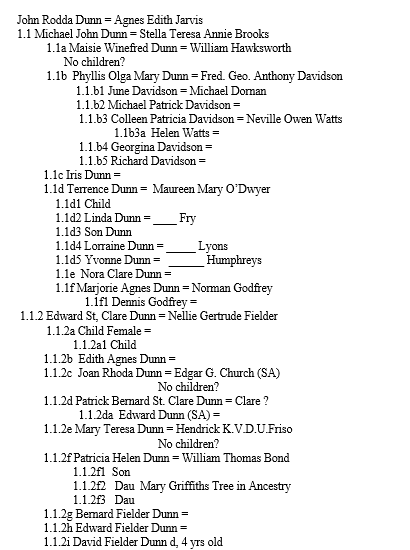
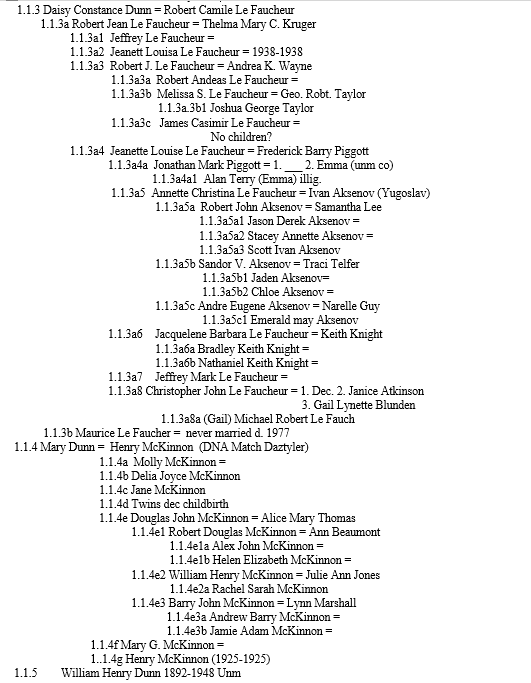
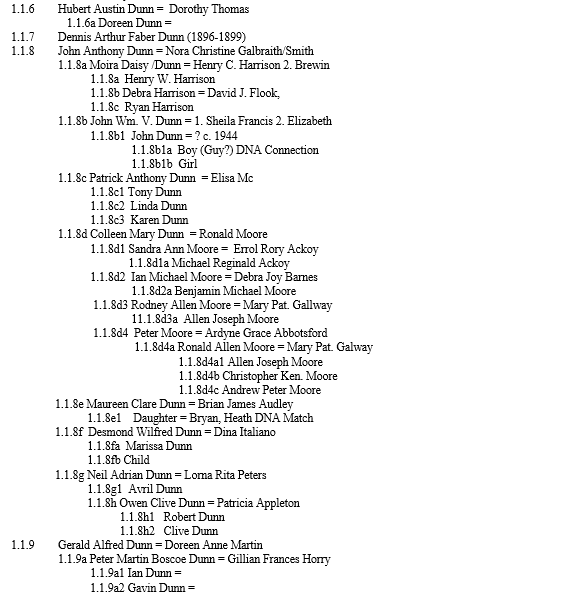
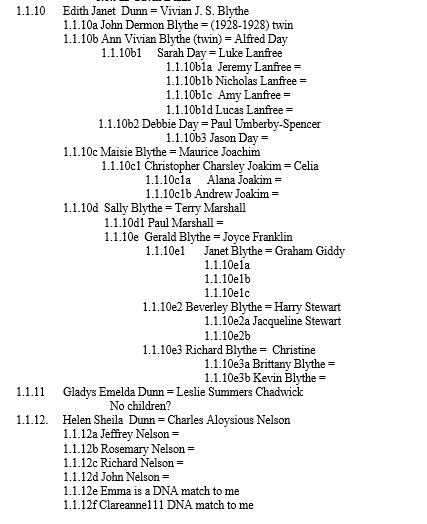
PEDIGREE OF THE DUNN/RODDA FAMILY IN INDIA
JOHN TAPP DUNN & HANNAH SOPHIA RODDA IN INDIA
THEIR ELDEST SON: JOHN RODDA DUNN
THEIR YOUNGEST SON: WILLIAM RODDA DUNN
THEIR ONLY DAUGHTER: ADA DAISY DUNN
John Tapp Dunn first appeared in Calcutta, Bengal in 1847 and a sweep of the directories available at the India Record Office at Orbit House, Blackfriars, London (now at the British Library), uncovered the following:
In 1847 he was 27 years old. He appeared as assistant to William Currie of the firm of Currie and Co. Cabinet Makers & Billiard Table Makers located at 64 Bentick Road, Cossitolla Street, Calcutta, Bengal, India.
In October of 1847, in the list of arrivals in Calcutta, I noted the arrival from England of Mrs. Rodda and child and set this aside as a person of interest.
On William Currie’s death in 1849, John Tapp Dunn purchased the firm and renamed it Dunn & Co., Cabinet Makers, Billiard Table Makers, and Upholsterers, located at the same address. In 1850 he was resident at 3 Loll Bazaar, Calcutta.
In the 1851 ship arrivals in Calcutta (Ref. IOL WT1216), on the SS Barham. I noted Mr. Rodda, Misses H and C Rodda, and W. Rodda. H. Rodda seems to be Hannah.
At about the same time, Henry Barber and Charles Swanemeyer Goebbles, of 64 Zig-Zag Lane, joined the firm as partners in the venture and the firm continued to do business in Calcutta and appeared in the Traders Lists for 1851 and 1853.
John Tapp Dunn, Henry Barber, Charles Swanemeyer Goebbles, and Dunn & Co., appeared in both the Trade Lists and inhabitants list for Calcutta, right up to 1852, when Robert Taylor joined the firm as a partner, and now trading as Dunn & Taylor, with the same partners, and John Tapp Dunn was noted as resident in Calcutta.
A year later, on April 30, 1853, John Tapp Dunn marries Hannah Sophia Rodda, at the St. James church in Calcutta; On the same page, but recorded in May of 1853, was Elizabeth Inshaw Rodda’s marriage to Robert Taylor; both brides name Richard Burrows Rodda, gunsmith, as father. I assumed the two were sisters, and their father Richard Burrows Rodda.
However, the mystery of whether this Dunn/Rodda connection was connected to my grandfather William Rodda Dunn, while obvious as to the differing names, had to be researched.
THE UNIDENTIFIED FOREIGN OBJECT
The imposing photograph of an older man over the doorway of our family home in Belgaum was a mystery to me. My grandmother, Carmelita Dunn, never spoke about him, refused to answer any questions, and generally frowned upon me, when I questioned her about him. I was 10 years old. One day, in irritation, she said his name, the same names as my father, William Rodda Dunn, and that he was born in Cork, Ireland.
10 years later, in 1964, I immigrated to the UK and stayed with my childhood and much beloved friend, Lorraine, and her husband. I had also married before leaving.
In 1970, on one of my trips to India, my dad decided to immigrate with the rest of the family, but our hopes of him and the family were stymied as we hit the proverbial road block – Patriality.
Patriality and its implications stymied some hopes, like for my family, who had to prove British roots with a grandfather’s “birth” (a christening was not accepted) in the UK, British India or abroad.
Firstly, as far as we understood it, to be considered Anglo Indian and/or Patrial, a person must descend from a European forefather, not from a European maternal line. The child of an Indian father resident in India and a European mother is not Anglo-Indian; he or she is ‘Indian.’ On the other hand, the child of an Anglo-Indian father resident in India and a mother who is Anglo-Indian or not, is an Anglo-Indian.
Secondly, an important point is the emphasis on the male line being European and not just British. Thus, in the Indian context, this would mean that the descendants of Portuguese, Dutch, French, and British forefathers would all be considered Anglo-Indians.
Furthermore, the armies of all these major powers in colonial India, as well as those of India, their children too, would be Anglo Indian. But the children born abroad of Anglo-Indians now settled overseas and who have become citizens there are not Anglo-Indians. They are persons of Indian origin and Anglo-Indian heritage but are British, Australian, Canadian, or whatever, dependent upon their orientation in these countries.
Unfortunately for me, I had nothing to go on. On asking my dad about his father, he produced a baptism certificate for him, with his birth date and baptism date 10 years after his birth at an orphanage in Calcutta. The orphanage turned out to be a Chinese orphanage and except for the baptism record nothing else turned up. However, dad found a baptism for a John Aloysious Dunn on the same day.
Inevitably, the baptisms of the sons of John Tapp Dunn and Hannah Sophia, nee Rodda were recorded: John Rodda Dunn August 5, 1854, William Rodda Dunn June 29, 1857. Their daughter Ada Daisy Dunn, born about 1859 (an estimated birth was noted) and recorded due to her marriage in 1879.
HANNAH SOPHIA RODDA IN INDIA
Hannah Sophia Rodda first appeared in Calcutta, Bengal, India, in 1851, on the ship SS “Barham” with her father, and Uncle.
– Mr. Rodda, Misses H Rodda, C, Rodda, and W. Rodda.
On April 30, 1853, she married John Tapp Dunn at the Anglican church of St. James in Calcutta. A notice of the marriage also appeared in the Bombay Times and Journal of Commerce – Mr. John Tapp Dunn to miss Hannah Sophia Rodda second daughter of R B Rodda, Esq. On the same page of the marriage record at the India Record Office, but on May 5, 1853, was the marriage of an Elizabeth Inshaw Rodda to Robert Taylor. Both brides named their father, Richard Burrows Rodda, gun maker of Calcutta, Bengal.
The Rodda family in India appeared to travel between the UK, India, and USA on a frequent basis from 1834 to 1855/6 and ceased from 1856/57 when the patriarch, Richard Burrows Rodda died in Springfield, Massachusetts, USA in 1856. His will was probated in both Bengal and Massachusetts. John Tapp Dunn was named executor of his will together with Richard Burrows Rodda’s wife, Elizabeth Rodda, nee Shepherd. However, probate was granted in Massachusetts solely in the name of Elizabeth Rodda, leaving me to assume that John Tapp Dunn renounced his executorship.
Passenger lists for John Tapp Dunn is still being researched for arrivals and departures between Calcutta and the UK and will be forthcoming presently.
Since no trace of the births of the three children mentioned above, were recorded anywhere in the three presidencies of Bengal, Bombay, and Madras, nor at St. Catherines House, in London for the relevant periods, the only alternative was the DNA matches on Ancestry and 23&me.
Between the two prominent DNA databases on Ancestry.com and 23&me, a total of 8000+ matches were found, which included DNA matches of the maternal lines. A painstaking task of trying to triangulate the various 1st to 8th cousins in direct relation to me was undertaken.
The initial DNA test in 2004 was analyzed on Ancestry.com, and by 2024, DNA matches on the paternal side (over 5000) or “jus sanguinis” (right of blood) concluded and verified that the three children were siblings, thereby validating all descendants of these three siblings, to me, on ancestry and 23&me. Thus, all descendant matches can and do have common ancestors in South Molton, Devonshire, England, Sancreed, Cornwall, England. These matches included collateral lines and Pedigree charts for a great number of DNA matches on ancestry, which further matched and enhanced Pedigree charts prepared by me in the 1980s.
THE DUNN SIBLINGS IN INDIA
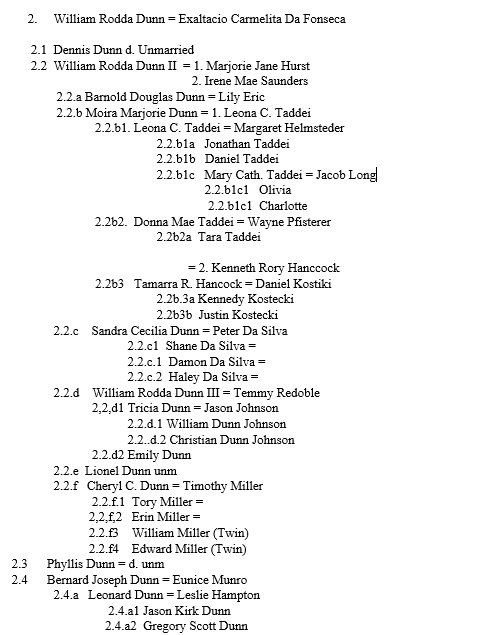
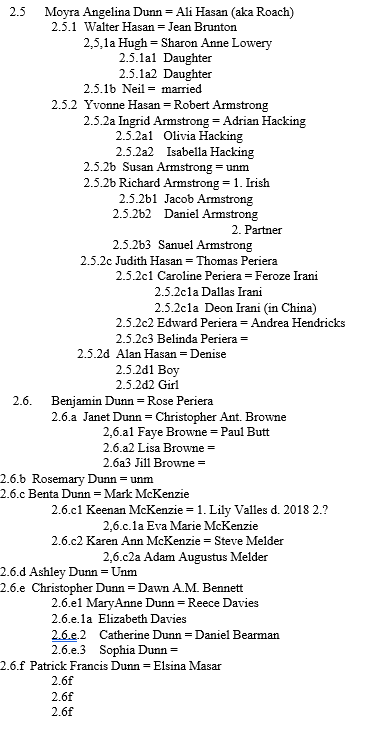
To name a few, the following charts show direct links to the three siblings, myself and the Dunn families in India between 1850 to the present day.
John Tapp Dunn died, presumably, in 1867. The death record was not found in India despite extensive research for the whole of India and its presidencies.
A brief background for John Rodda Dunn, the eldest son.
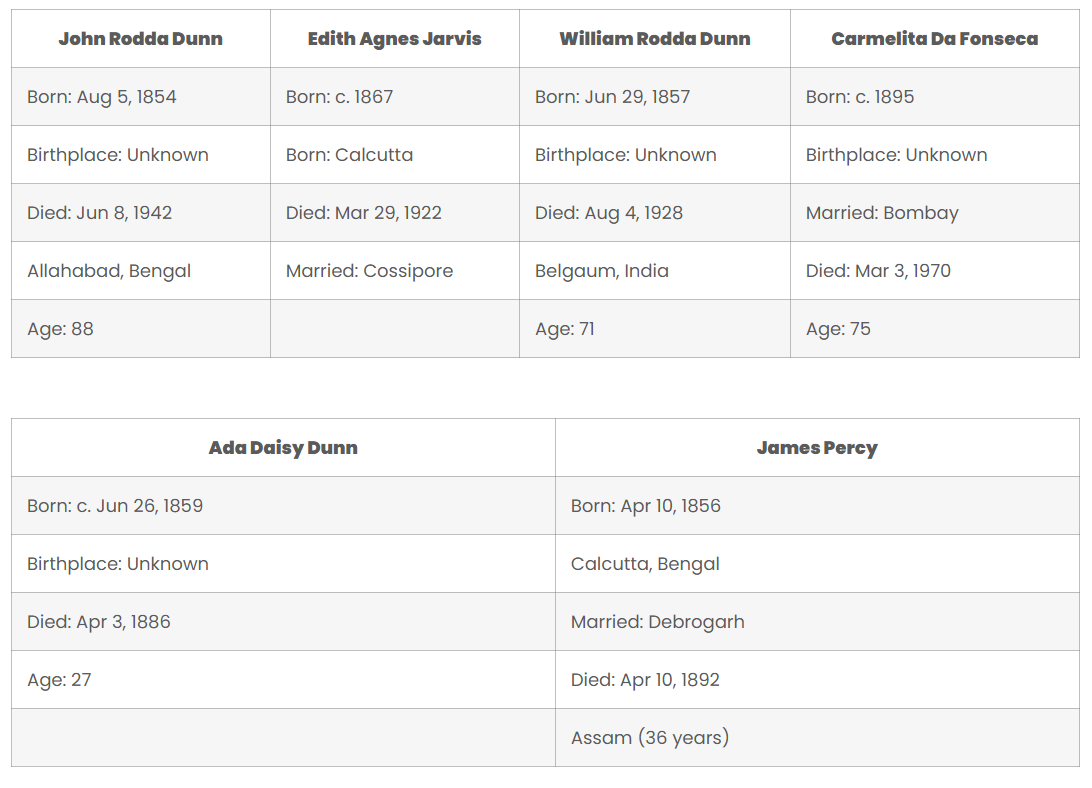
John Rodda Dunn was baptized into the Catholic religion on March 28, 1867, and placed in the Moorghetha Orphanage.
He was 13 years old. His baptismal name was John Aloysious Dunn.
He remained in the orphanage until he was 16 years old and then became a member of the Irish Christian Brothers
Organization, run by Jesuit priests at the time. Apparently, he remained there for several years before leaving the organization to marry. He married Edith Agnes Jarvis on June 29, 1884, daughter of Edward Jarvis Edward Jarvis, a Captain in the Merchant Service, and Edward Gill. The marriage was solemnized at the Catholic Cathedral. He was listed as a guard in the East India Railway and was a resident of Cossipore. The witness to his marriage was William Rodder Dunn, his brother, and William Henry Burke.
John Rodda Dunn and Edith Agnes Jarvis had 12 children.
A brief background for William Rodda Dunn, the youngest son.
William Rodda Dunn married Exaltacio Carmelita Da Fonseca in Bombay in 1910. They had 6 children.
He was baptized into the Catholic religion on March 28, 1867, and placed in the Moorghetha Orphanage. He was 8 years old. His baptismal name was William Stanislaus Dunn.
He remained in the orphanage until he was 16 years old and then became a member of the Irish Christian Brothers Organization about 1873, run by Jesuit priests at the time. His brother John Rodda Dunn became a member earlier. Apparently, he remained there for several years before leaving the organization, presumably after his brother married Edith Agnes Jarvis in 1884.
He joined the Public Works Department in Calcutta in 1884 and was transferred across the three (3) presidencies of Bengal, Bombay, and Madras, up to the time of his death on August 4, 1928.
He married Exaltacio Carmelita Da Fonseca in Bombay on April 4, 1910, in Bombay, India. They had six children. Prior to his death in 1928, he purchased a home, B.C. 110 Camp Belgaum, Maharashtra State, Bombay presidency, and lived there with his wife and children until his death. The property was sold about 2015 after about 100 years in our possession.
A brief background for their only daughter, Ada Daisy Dunn
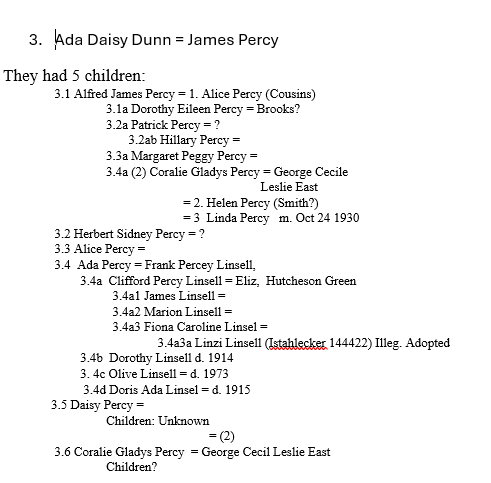
Ada Daisy Dunn (1) = James Percy = (2) Isabella Emily Little (Batho)
Ada Daisy Dunn’s birth was not recorded at the India Record Office at Orbit House, Blackfriars, London, nor at St. Catherine’s House, in London. She was 2 years old when her mother died and 8 years old when her father presumably died in 1867.
Where she was placed in 1867 needs to be researched. On researching the records at the India Record Office for the year 1879, I found her marriage to James Percy, an Indigo planter in Assam. They had 5 children.
Ada died in 1886 at the age of 27 years
After Ada Daisy’s death in 1886, James married Isabella Emily Little (Batho) soon after and they had one child, Coralie Gladys Percy who married George Cecil Leslie East in the UK.
CONCLUSION:
The DNA matches to me were validated, as in most instances, I was matched to each of those who had taken a test on ancestry.com or 23&me and will be shown in later blogs.
TO BE CONTINUED: